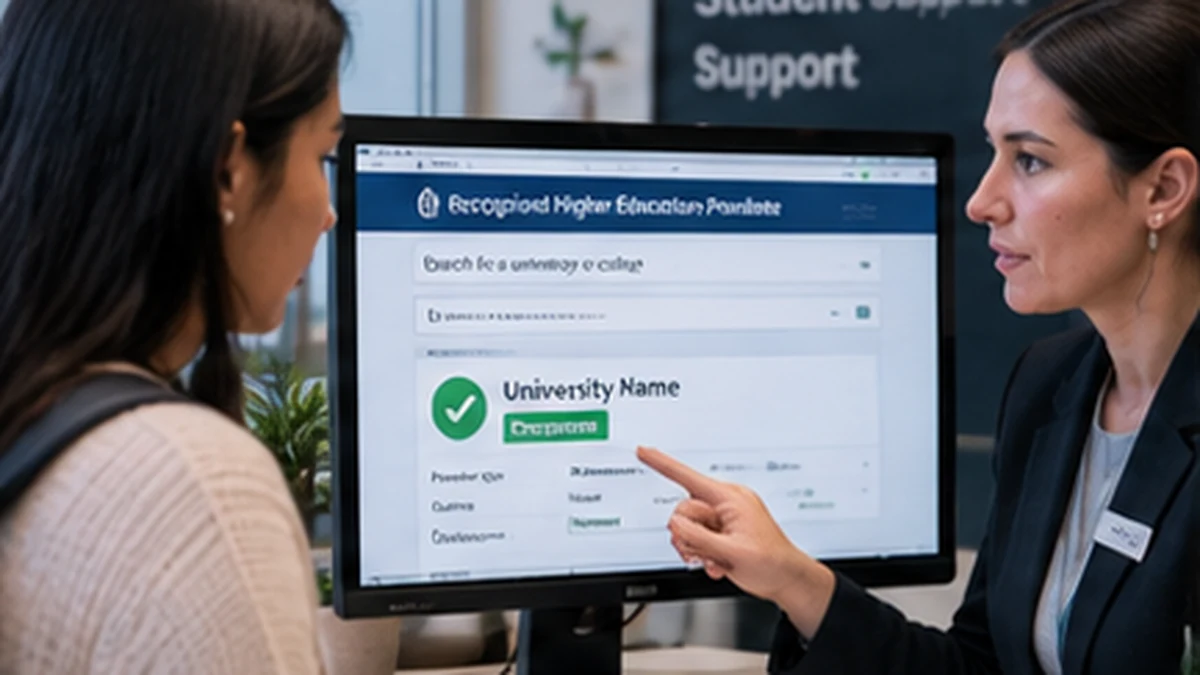
Verify accreditation and recognition Accreditation and recognition can affect whether a qualification is accepted for employment, further study, licensing, credit transfer, immigration or professional registration. The exact system differs by country, so learners should verify status through the national competent authority or another recognized official source rather than relying on a provider’s own claims.
This guide is designed to help learners make careful education decisions using evidence, official sources and realistic planning. Education systems differ by country and institution, so local rules, recognition and policies should always be checked through the appropriate authority. In this verify accreditation and recognition guide, apply the principle to the exact provider, program and country you are considering.
Verify accreditation and recognition at institution level first
Check whether the institution is recognized by the national authority responsible for higher education in the country where it is established. For higher-education institutions, the IAU/UNESCO World Higher Education Database can be a useful global reference.
After this section, write one sentence describing what you know and one describing what still needs verification. This keeps verify accreditation and recognition grounded in evidence instead of assumptions.
For a stronger decision, compare at least two pieces of evidence related to verify accreditation and recognition at institution level first: one from the provider or program itself and one from an independent or official source. The comparison helps you see where marketing language ends and verifiable information begins.
Check the program, not only the institution
An institution may be recognized while a particular program has additional approval requirements. This is common in regulated fields such as nursing, teaching, engineering, law or health professions.
Use this section as a checkpoint: if the answer would change your choice, cost, eligibility or safety, verify it before moving forward with verify accreditation and recognition.
For a stronger decision, compare at least two pieces of evidence related to check the program, not only the institution: one from the provider or program itself and one from an independent or official source. The comparison helps you see where marketing language ends and verifiable information begins.
Understand recognition versus membership or ranking
Professional associations, private quality labels, rankings, memberships and partnerships can be useful, but they are not automatically the same as legal recognition or academic accreditation.
Keep a short note of the source, date checked and any condition attached to the information. Education decisions often unfold over weeks, and details can be forgotten.
For a stronger decision, compare at least two pieces of evidence related to understand recognition versus membership or ranking: one from the provider or program itself and one from an independent or official source. The comparison helps you see where marketing language ends and verifiable information begins.
Verify cross-border and online programs carefully
Online programs can be legitimate, but recognition may depend on the institution’s home country, the learner’s country, professional rules or how the program is delivered. Check how the qualification will be used where you plan to use it.
If the answer is unclear, ask the institution or competent authority a focused question rather than filling the gap with guesswork. That small habit improves verify accreditation and recognition quality.
For a stronger decision, compare at least two pieces of evidence related to verify cross-border and online programs carefully: one from the provider or program itself and one from an independent or official source. The comparison helps you see where marketing language ends and verifiable information begins.
Check professional licensing and further-study rules separately
Graduating from a recognized program does not always mean you can immediately work in a regulated profession. Likewise, a receiving university may have its own rules for admitting students or recognizing previous qualifications.
Decide whether this point is mandatory, optional or simply useful. Separating those categories prevents verify accreditation and recognition from becoming overloaded with low-priority details.
For a stronger decision, compare at least two pieces of evidence related to check professional licensing and further-study rules separately: one from the provider or program itself and one from an independent or official source. The comparison helps you see where marketing language ends and verifiable information begins.
A realistic education example
A student finds an online university with professional branding and a long list of “international accreditations.” Instead of trusting the badges, the student checks the national higher-education authority and WHED, then verifies whether the specific online program has the recognition needed for postgraduate admission. The process reveals that some badges are memberships, not degree recognition.
The lesson is not that every learner should make the same choice. It shows how verify accreditation and recognition becomes more reliable when the student compares recognition, learning quality, cost, support and practical fit before making an irreversible commitment.
Connect this decision to the rest of your education plan
Use compare providers after recognition is confirmed when that becomes the next question, and review run a wider provider verification before paying when you need to strengthen another part of the decision.
Education planning works best as a sequence. Resolve the highest-risk question first, then move to the next decision instead of trying to optimize every part of verify accreditation and recognition at once.
Common mistakes with verify accreditation and recognition
- Trusting logos on a provider website.
- Checking only the institution and not the program.
- Confusing membership with accreditation.
- Assuming recognition automatically transfers across borders.
- Forgetting professional licensing requirements.
These mistakes are common because education decisions mix hope, urgency, money and long-term goals. Slowing the process enough to verify each important claim can prevent expensive corrections later.
A seven-day action plan for verify accreditation and recognition
Day 1: define the outcome and gather the information you already have. Day 2: verify official recognition or provider status where relevant. Day 3: compare curriculum, format or requirements. Day 4: calculate cost and time. Day 5: check support, policies or transfer rules. Day 6: identify risks and unanswered questions. Day 7: review the evidence and decide whether to proceed, pause or compare another option. In this verify accreditation and recognition guide, apply the principle to the exact provider, program and country you are considering.
This schedule is only a framework. Some education decisions need more time because institutions respond slowly, transfer evaluations take weeks, or financial plans require family discussion. The purpose is to organize verify accreditation and recognition, not rush it.
Practical checklist
- Institution status checked
- Program status checked
- Accreditor verified independently
- Professional licensing checked if relevant
- Cross-border recognition researched
- Further-study rules checked
- Verification record saved
- Unclear claims resolved before payment
Use the checklist to reveal missing information, not to force a quick yes-or-no answer. A strong verify accreditation and recognition decision is one where the remaining uncertainty is visible and acceptable.
What to do when recognition is difficult to confirm
Contact the competent authority directly and ask what information is needed to verify the institution or qualification. Use the exact legal name, country, awarding body, campus, and program title rather than a shortened marketing name.
If the provider operates through a franchise, validation partner, branch campus, or teaching center, confirm that relationship. Recognition can depend on which organization actually awards the qualification and whether the partnership is officially approved.
Keep separate records for academic and professional recognition
Academic recognition may determine whether a qualification is accepted for further study, while professional recognition may determine whether you can work in a regulated occupation. These decisions can come from different authorities.
Create two verification notes when both matter. One should show the institution and credential status; the other should show the licensing or professional route. This avoids assuming that one approval automatically solves the other.
Recheck status before final enrollment or graduation plans
Recognition information can change, particularly when a provider changes ownership, campus, program structure, or partnership arrangements. Recheck the official status before making a major payment and again if the program changes while you are enrolled.
If you intend to use the qualification internationally, also confirm how the destination country evaluates foreign credentials. A legitimate qualification may still require a formal recognition or equivalency process elsewhere.
Frequently Asked Questions
Does WHED list every type of education provider?
No. WHED focuses on recognized higher-education institutions meeting its criteria. Short-course or vocational providers may require verification through other national authorities.
Is a private accreditation label enough?
Not necessarily. You need to understand who issued it and whether that organization has authority relevant to your purpose.
Can a recognized degree still need professional licensing?
Yes. Regulated professions often have separate licensing or registration requirements.
What if the provider says recognition is pending?
Treat pending recognition as different from current recognition. Decide based on the status that exists now unless the official authority states otherwise.
Questions to ask before you make the final decision
Before you commit, write down the three questions that could still change your decision about verify accreditation and recognition. One question should be about quality or recognition, one about cost or time, and one about what happens after completion. This simple exercise stops minor details from crowding out the questions that could genuinely change the value of the education choice.
When you ask an institution or provider a question, look for a specific answer rather than reassurance. Names, policies, dates, official links, written conditions, and examples are more useful than phrases such as “don’t worry” or “everyone accepts this.” Keep important answers with your application or enrollment records so the decision remains traceable later. For How to Verify Accreditation and Recognition Before Enrolling, keep this review tied to the specific institution, learning format, and outcome you selected.
How to document your research
Create one private folder for How to Verify Accreditation and Recognition Before Enrolling. Save the official program page, recognition or registry result, fee schedule, curriculum, support information, important emails, refund rules, and any comparison notes. Add the date beside information that may change. A clean research file helps you avoid repeating the same searches and makes it easier to explain why you chose the program.
Documentation is particularly useful when the decision takes several months. Tuition may change, staff may leave, pages may be updated, or your own priorities may shift. Keeping the original evidence does not mean you should ignore newer information; it gives you a reliable baseline for comparing what changed and deciding whether the change matters. For How to Verify Accreditation and Recognition Before Enrolling, keep this review tied to the specific institution, learning format, and outcome you selected.
Review the decision after you start
Enrollment is not the end of verify accreditation and recognition. During the first meaningful stage of the program, compare the real experience with the evidence you used before enrolling. Check teaching quality, workload, access to support, unexpected costs, assessment, communication, and whether the program is building the knowledge or evidence you expected.
If something is different, identify whether it is a normal adjustment problem or a structural issue. New students often need time to adapt to pace and expectations, but unrecognized credentials, hidden fees, unavailable support, or major differences between the advertised and delivered program deserve a more serious response. A review habit helps you act on problems while options may still be open. For How to Verify Accreditation and Recognition Before Enrolling, keep this review tied to the specific institution, learning format, and outcome you selected.
Authoritative resource to review
For an authoritative reference related to this topic, review IAU/UNESCO World Higher Education Database. Education systems differ by country, so use the official national authority, institution or regulator when a local recognition or legal question matters.
Final perspective
Verify accreditation and recognition becomes easier when the decision is built from verified information rather than urgency or marketing. Compare the evidence, protect your money and personal information, and keep a record of the sources that shaped your choice.